For federal defendants — and the people who love them
Surviving Pretrial is the 540-page survival guide to the federal criminal process — from the moment the handcuffs click to the day the judge hands down a sentence. Written by Bilal Khan, who lived every page of it, in language you can actually read at 2 a.m. Read it tonight — before the first five-figure decision gets made in a panic.
Someone inside? Detention centers generally accept paperbacks shipped directly from a bookstore — order it on Amazon and ship it straight to their facility.
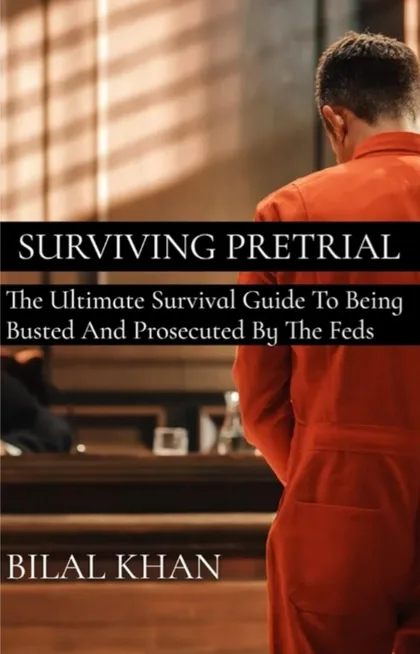
Surviving the Feds · Vol. 1 · Published 2023

It's late. The arrest just happened.
These are free, no email required. Come back for the book when you're ready.
Start here — before the money moves
Private federal defense generally starts at a five-figure retainer, and complex cases can climb far higher. Families wire that money within days of an arrest — in a panic, with no way to judge what they're buying. The cheapest thing you will ever do in this case is understand the system first. Nobody hands you a map. Everybody hands you a bill.
The lawyer who answers at 2 a.m. and guarantees an outcome for a big retainer is selling, not defending — no honest federal practitioner promises results. The book shows you how to vet counsel before you pay, not after.
Keeping the federal defender or hiring private counsel is a real decision, not a default — federal defenders practice in federal court every day. What matters is evaluating the lawyer in front of you, and the book gives you that framework.
A family that knows the process can tell whether counsel is preparing for the detention hearing or coasting to a plea. One verified reviewer put it plainly: "I was more surprised to find out our lawyer was lying to us."
Free, right now: the six-point "Is my lawyer any good?" checklist →
The road ahead
Prosecutors use their superior knowledge of the system as a weapon. This is the map that levels the field — each stage below is covered in depth, in plain English.
Stage 01 — right now
Booking, U.S. Marshals custody, the first phone call, and the mistakes people make in the first three days — on recorded lines, with agents, and online — that follow the case forever.
In the book: what happens from the moment the handcuffs click, and what to do about it.Stage 02 — within days
The hearing that decides whether they wait for trial at home or in a cell. Flight risk, danger to the community, release conditions — and what a family can put in front of the judge.
In the book: exactly what happens at a detention hearing and how to fight for bail.Stage 03 — the first months
Arraignment, preliminary hearing, suppression hearing, motions — a plain-English crash course in what each one is actually for, so nothing in the courtroom is a surprise.
In the book: decoding every court hearing, from initial appearance to suppression.Stage 04 — the decision
Most federal cases end in a plea — but few defendants know there's more than one kind, or how to read the discretionary language prosecutors build into agreements.
In the book: how to read a plea agreement, spot the traps, understand the Safety Valve, and negotiate.Stage 05 — before sentencing
The interview and report that can shape the sentence more than anything said in court — including "ghost dope," drug amounts that were never seized but still count against you.
In the book: mastering the PSR, challenging ghost dope, and correcting the record before it hardens.Stage 06 — the day
Guidelines, variances, allocution, and what families can do in the weeks before — so the last day of pretrial isn't the first day anyone thought about it.
In the book: preparing for sentencing with everything the earlier chapters set up.Inside the book
Many defense lawyers assume you won't understand the law, talk over your head, and leave you out of the strategy. Surviving Pretrial exists to end that.
How to vet, hire, and manage a criminal defense attorney — and how to know if they're actually fighting for you or just taking your money.
What happens at a detention hearing, and how to show a judge that your person isn't a flight risk or a danger to the community.
A plain-English crash course in criminal procedure: initial appearance, arraignment, preliminary hearing, suppression hearing — what each is really for.
How to read a plea agreement, spot the discretionary language prosecutors use, understand the Safety Valve, and negotiate effectively.
How to challenge quantities that were never seized, correct the report, and stop paper allegations from becoming years of a sentence.
How the guidelines actually work, what moves a judge, and how the whole pretrial fight sets up the number that gets read out loud.
Real Amazon reviews
Every review of Surviving Pretrial on Amazon is five stars. These are all of them — unedited, from the people the book was written for.
"A true must read the day you are arrested by the feds"
One of the best reads and a true look into what is going to happen the day after you are arrested. The most important lesson you MUST know is how the system works and how to navigate your way through it. Not only is this a must have for a defendant but also your family. Once you are arrested it truly is the United States of America against YOU… The ONLY hope you have is educating yourself and this book is exactly where you need to start.
"Life saver"
I read this book and sent it to my cousin who is in the federal system… We have been terrified ever since this whole thing took off… But for the first time we feel as there is a light at the end of the tunnel. The part of this book that is most relevant to our situation was about hiring a lawyer and plea bargains. We have been able to communicate with the lawyer more easily and now know there are different types of plea bargains… This book has already been a life saver.
"Way more info than Busted"
My brother is in jail and I have been reading everything I could on the subject. I bought him Busted by the Feds and he asked if there was anything else out there that gives more information. I got the kindle version of Surviving Pretrial and am highly impressed… I was more surprised to find out our lawyer was lying to us… Anyone facing the feds in court should get this book. It's great.
"Much Better Than Busted By the Feds"
I've ordered both this title and the Busted By the Feds title for my son who was targeted by the government and is in detention as I write this. He and all those in the detention center have told me that Surviving Pretrial is more detailed, more updated, and more usable… The book contains a plethora of information and advice from an author who clearly knows the subject matter.
"Awesome insight! Can't believe I found this!"
My brother asked me to pick up "Busted by the Feds" since it's all people in jail talk about. When I told him about "Surviving Pretrial" and that it has insider details that only someone who has DONE time could tell him… we took a chance. And he LOVED IT.
Try before you buy
Open the official Kindle preview without leaving this page. If it reads like it was written for you — it was.
No email address, no signup. The preview is served by Amazon and picks up right where the book begins. When you're ready, the full 540 pages are one tap away.
Prefer the sample on your Kindle app? Open it on Amazon.
The jailhouse classic, compared
For decades, Busted by the Feds was the book that got passed around county jails. Three of the five Amazon reviews of Surviving Pretrial compare the two directly. Here are the checkable facts:
| Surviving Pretrial | Busted by the Feds | |
|---|---|---|
| Author | Bilal Khan — living, answering questions at survivingthefeds.com | Larry Fassler — passed away in federal custody; no further editions |
| Written for | Defendants and their families, in plain English | Defendants; heavy focus on drug cases |
| Price | $24.99 Kindle (free on Kindle Unlimited) · normal paperback pricing | Editions commonly listed at $150+ on Amazon |
| Formats | Kindle, Kindle Unlimited, paperback — readable tonight | Paperback only |
| Maintained | Backed by a living author and an active site of free guides | Last edition 2023; no website, no updates |
Questions families ask at 2 a.m.
Generally: stay calm, don't discuss the case with agents or on recorded jail lines, and find out where your family member is being held and when their initial appearance is. Everything moves fast in the first 72 hours — the detention question is usually decided within days. Start with our free First 72 Hours guide, then get informed about the process itself.
Federal arrestees are generally held by the U.S. Marshals Service, often in a local jail or a federal detention center. The criminal docket for the initial appearance (searchable on PACER) shows the court, and the Marshals or the courthouse clerk's office can generally confirm the facility. Our free guide walks through it step by step.
The federal system generally doesn't work like state cash bail. Release or detention is decided by a judge at a detention hearing, based on flight risk and danger to the community — usually through release conditions rather than a money bond you post. That hearing is often the family's single most important early moment, and the book covers how to prepare for it in depth.
A judge generally hears from the prosecutor and the defense about whether the defendant is a flight risk or a danger to the community, then orders release with conditions or pretrial detention. Families can matter here: stable housing, employment, and a credible third-party custodian are the kinds of factors courts generally consider. Surviving Pretrial devotes full chapters to this hearing.
No — an indictment is a formal charge, not a conviction. But the federal government's conviction rate is famously high, and most federal cases end in plea agreements rather than trials. That's exactly why understanding the process — what each hearing is for, how plea offers work, what the presentence report controls — changes the decisions a defendant is able to make.
Generally much longer than families expect — often many months, sometimes years. Continuances are routine, discovery can be enormous, and plea negotiations have their own rhythm. A long timeline is normal and is not by itself a bad sign. Knowing the stages ahead makes the waiting survivable.
You're allowed to evaluate the lawyer — even a court-appointed one. Do they explain strategy in plain English, return calls, and prepare for the detention hearing like it matters? The book includes a full framework for vetting, hiring, and managing defense counsel. There's also a free checklist on our main site: Is my lawyer any good?
Private federal defense generally starts at a five-figure retainer, and complex cases or trials can cost far more — fees vary widely by district, charges, and lawyer. Whatever you spend, an informed client gets more for it: you can't judge whether counsel is worth the money if you don't know what they should be doing. That's the case for spending $25 on understanding the process before the retainer.
Not automatically — federal defenders practice in federal court every single day and are genuine specialists, while private counsel varies enormously. The real question isn't the label, it's the lawyer: do they explain strategy, prepare hard for the detention hearing, and know this courthouse? Surviving Pretrial gives you the framework to evaluate whoever is on the case before more money moves.
"Ghost dope" is jailhouse shorthand for drug quantities attributed to a defendant at sentencing that were never seized — amounts based on testimony or estimates rather than drugs on a table. Because federal drug sentences are driven by quantity, those paper amounts can raise a sentence dramatically. The book explains how ghost dope shows up in the presentence report and how it's generally challenged.
Generally yes. Federal facilities typically require books to be paperback and shipped directly from a publisher or bookstore — which includes Amazon. Order the paperback and have Amazon ship it straight to the facility (check the facility's mail rules for its required address format first).
Busted by the Feds is the classic jailhouse manual, but its author has passed away and editions commonly sell for over $100. Surviving Pretrial was written in this era by a living author who went through the system himself, addresses families as well as defendants, and costs what a normal book costs — free on Kindle Unlimited. Read the full comparison.
One book. One price. No upsell.
Start reading in the next two minutes on any phone, or put the paperback in their hands inside.